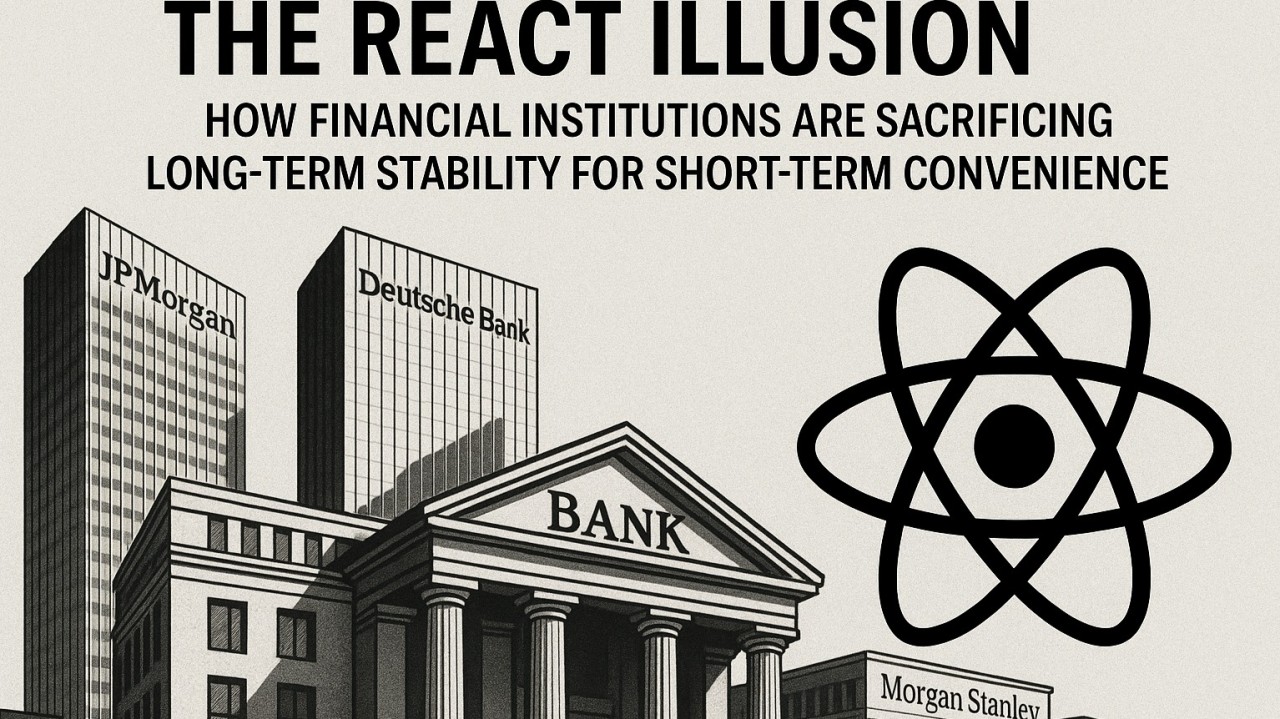
The React Illusion: Balancing Short-Term Delivery with Long-Term Stability in Financial Systems
The hiring pattern across major banks is clear: front-end roles overwhelmingly demand React. Angular, once the enterprise default, has become rare.
React’s dominance is often interpreted as technical superiority. In practice, it reflects short-term pressures: rapid delivery, large talent pools, and fast onboarding. These are legitimate needs. The deeper question is what costs are being deferred into the future.
React’s Immediate Strengths
- Large talent pool: easier staffing and replacement.
- Lightweight core: developers onboard quickly and show progress fast.
- Component model: accelerates modular delivery.
- Flexibility: teams can solve problems in multiple ways.
For managers evaluated on quarterly delivery, React creates visible momentum.
The Long-Term Risks
- Inconsistent architectures: flexibility leads to “ten teams, ten patterns.”
- State management sprawl: without governance, flows become hard to audit.
- Audit challenges: tracing UI state under GDPR, MiFID II, or DORA is difficult.
- Maintenance drag: fragmented dependencies increase long-term cost.
- Rewrites and transformations: cycles of “fixing the fix” emerge.
In regulated environments, these are not theoretical concerns. They become operational and regulatory risk.
Why Institutions Choose React Anyway
- Delivery today outweighs resilience tomorrow.
- Leadership turnover pushes long-term rot onto successors.
- Compliance focuses on passing minimum checks now.
React fits neatly into this incentive structure.
What Safer Front-End Models Look Like
- Angular as a core framework: enforced structure, routing, and dependency injection.
- NgRx state management: immutable, auditable transitions.
- Strict TypeScript: compile-time guarantees reduce runtime surprises.
- Controlled design systems: versioned, compliance-checked components.
- Mandatory testing and gated releases: traceable, reproducible deployments.
This model deliberately trades short-term developer freedom for institutional safety—the trade financial systems require.
Why Angular Aligns with Compliance Needs
- Routing and guards: controlled access.
- Dependency injection: centralized service governance.
- NgRx: enforced, traceable state changes.
- RBAC and OIDC: secured user journeys.
- Strict typing: data integrity guarantees.
- Standardized builds and design systems: protection against drift and supply-chain risk.
These are not optional optimizations. They are foundational to long-term compliance and operational trust.
React vs. Angular: Context Matters
React emerged from startup culture prioritizing speed and adaptability. Angular was designed for enterprise environments prioritizing governance and stability. Choosing React in banking imports a startup philosophy into a regulated system—useful for speed, risky for survivability.
The Real Choice
Financial systems should not aim to be just good enough to pass today’s audit. They should be engineered to endure decades of scrutiny, turnover, and regulatory change.
React solves short-term staffing problems. Angular, with proper governance, addresses long-term stability. Institutions that recognize this difference build systems with discipline, predictability, and resilience at their core.
Closing thought: In finance, what looks flexible today often proves fragile tomorrow. True excellence is not speed alone—it is systems designed to survive.