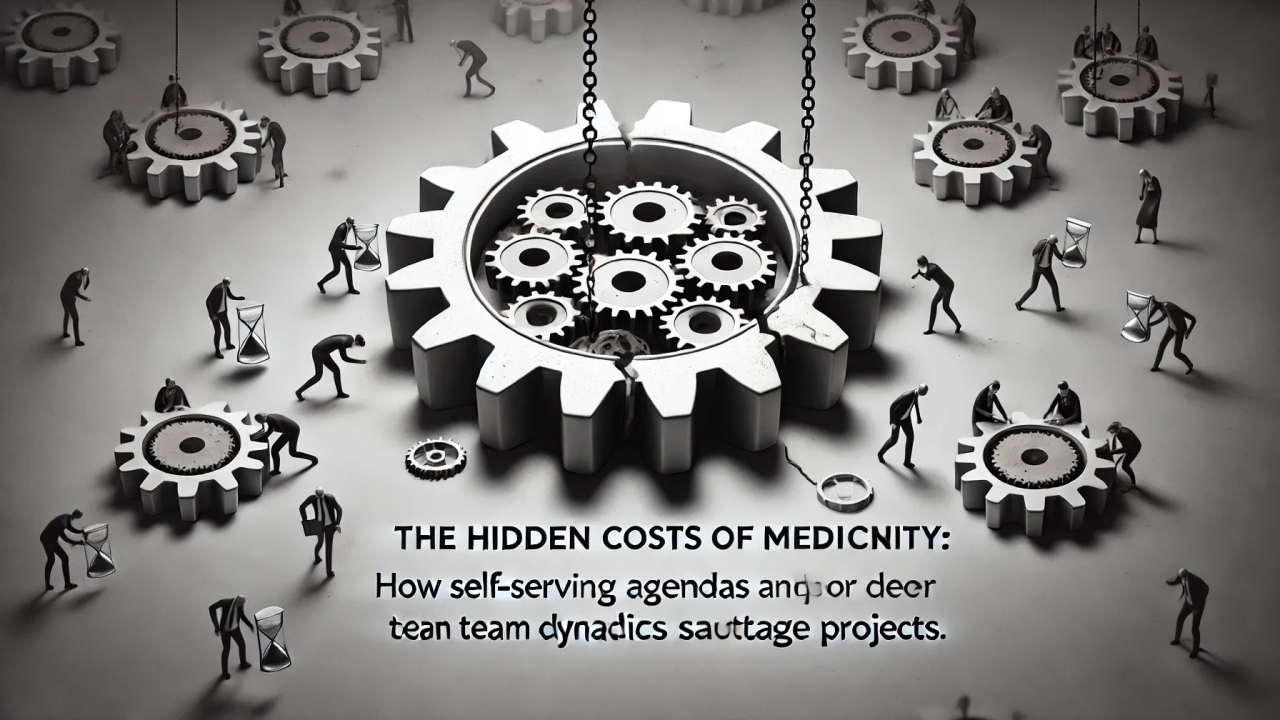
The Hidden Costs of Mediocrity: How Poor Team Dynamics Sabotage Projects
In technology, success depends on more than technical brilliance. What ultimately defines outcomes is the collective strength of the team: its mindset, accountability, and ability to collaborate with purpose. When political games, self-serving agendas, or weak ownership creep in, innovation stalls and projects lose their potential. Mediocrity does not just limit individuals — it drags down the entire effort, compromising quality, momentum, and long-term legacy.
1. Mistaking Quantity for Progress
Many organizations emphasize output over impact. Teams that rush to deliver visible results often sacrifice quality and innovation for short-term gains.
On the surface, productivity appears high. In reality, constant patching and reworking lead to technical debt, fragile systems, and burned-out engineers. When speed is mistaken for progress, the true cost is sustainability and innovation.
2. The Cost of Self-Serving Politics
Toxic dynamics emerge when individuals focus more on perception than contribution. Political maneuvering — positioning oneself favorably with management while avoiding accountability — erodes trust and undermines progress.
While such behavior may go unnoticed temporarily, the damage is real: projects lose momentum, morale declines, and the gap between appearance and reality widens. Teams that reward image over substance eventually pay the price in stalled execution.
3. Weak Ownership and the Reactive Spiral
Ownership is a cornerstone of successful projects. When team members avoid responsibility, deadlines slip, tasks are left incomplete, and quality suffers. Others are forced to pick up the slack, dragging the entire team into a reactive cycle.
Without leaders who model accountability, projects lose direction. Instead of innovating, teams are consumed with fixing preventable issues — a cycle that reinforces mediocrity.
4. The Damage to Project Legacy
Every project has the potential to shape an organization’s reputation and future. But when mediocrity is tolerated — through politics, shortcuts, or weak ownership — projects become remembered for missed opportunities rather than lasting contributions.
The legacy of such work is wasted resources, diluted impact, and diminished credibility. Organizations that allow self-serving agendas to dominate pay not just in project outcomes, but in long-term reputation.
Conclusion
Mediocrity is rarely the result of technical limits — it stems from culture. When political maneuvering replaces accountability, when speed replaces quality, and when ownership is absent, projects falter.
Leaders who prioritize accountability, quality, and collective ownership create the conditions for innovation. Without this foundation, teams risk leaving behind projects remembered not for achievement, but for the opportunities they squandered.